On this page
- What is a kabaddi betting ID?
- The PKL season
- The rules in ninety seconds
- Raid markets, decoded
- Why kabaddi prices are beatable
- Reading a PKL match-up
- Team news and the minutes that matter
- For cricket players: the translation table
- In-play: the forty-minute sprint
- Season outrights: the slow trade
- Five kabaddi mistakes
- Get your kabaddi ID in 5 minutes
- Frequently asked questions
What is a kabaddi betting ID?
A kabaddi betting ID is your exchange login with the Pro Kabaddi League book attached – match winner, total points, raid and tackle markets, priced live through every raid. It is also the rarest product on this site: most desks in India simply do not carry kabaddi, or carry a lonely match-winner line and call it coverage. We run the full book through the season, on the same wallet as cricket, tennis, football and the casino floor.
Fixtures, squads and the season calendar are published by the league itself at Pro Kabaddi – the schedule moves more than cricket’s does, so check it before a double-header week.
Search the market yourself and notice what ranks for kabaddi betting: offshore bookmakers, affiliate lists, tips pages. Almost nobody who actually issues IDs bothers with the sport. That neglect is not a warning – it is the opportunity, and the section on beatable prices below explains exactly why.
The PKL season
The Pro Kabaddi League runs a long autumn-into-winter season – a dozen franchises, a double round-robin of league play, then playoffs and a final. That shape matters for betting: a match almost every evening for weeks means form is fresh and visible, squads settle into rotations you can learn, and outright markets stay alive long enough to trade as the table develops. Around the PKL sit the national sides’ competitions and state leagues; the PKL is where the liquidity and the coverage live, and where a kabaddi betting ID earns its place through the cricket off-season evenings.
The rules in ninety seconds – enough to bet
You do not need a childhood on the mat to read these markets; you need four mechanics. A raid lasts thirty seconds: one raider crosses into seven defenders, scores a point for every man he touches if he returns, concedes one if he is tackled. The bonus line hands a cheap point for a deep step when six or more defenders are on the mat – which is why trailing defences suddenly stop conceding it. Every defender the raider touches out is revived in reverse order when his own team scores, so leads compound: points now buy bodies later. And emptying the entire opposition mat is an all-out – two bonus points plus full revival, the swing event every in-play price orbits around. That is the whole engine. Everything in the market decoder above is these four mechanics wearing different clothes.
It is also, conveniently, an evening sport in Indian time – prime-time starts, matches short enough to watch whole, and a fixture nearly every night for weeks. As a day-to-day rhythm for an ID, the PKL season is what the IPL is in April: reliable, watchable, and over by bedtime.
Raid markets, decoded
Kabaddi’s scoring rhythm – a point attempt every thirty seconds, all match long – produces a market menu no other sport offers. Nobody explains it, so here is the decoder.
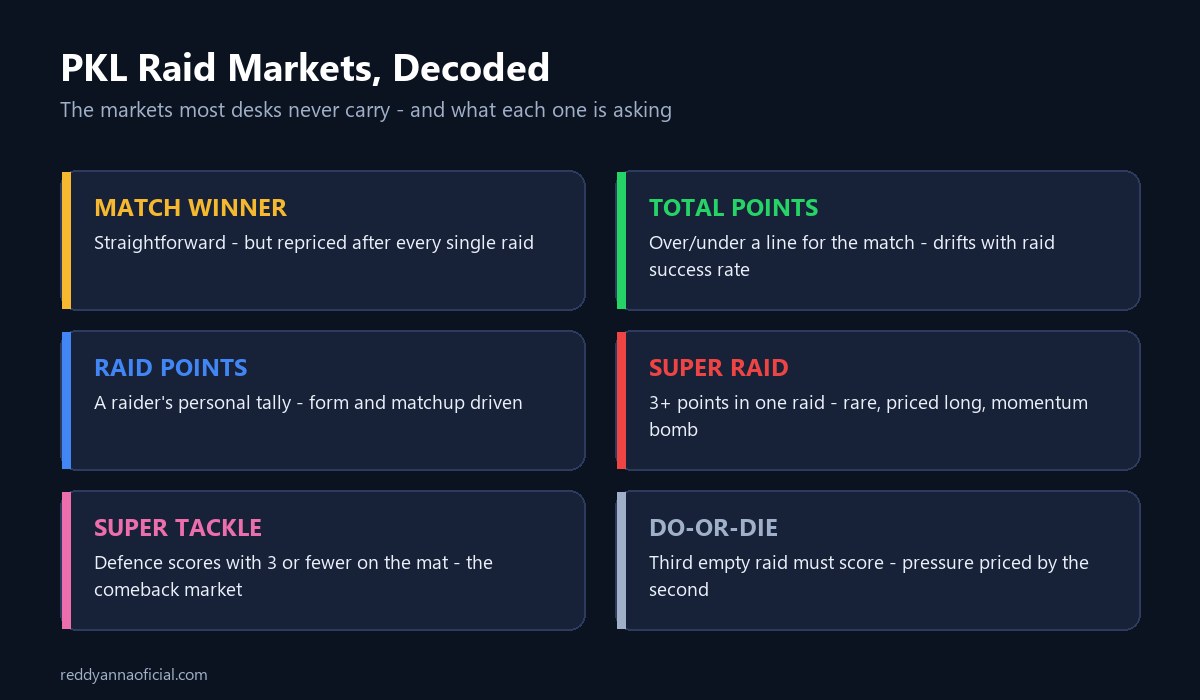
- Match winner – the anchor, repriced after every raid rather than every over. Comebacks are constant; so are overreactions.
- Total points – over/under a line for the match. Really a judgement about defensive quality: two strong cover units drag totals down fast.
- Raider points – one raider’s personal tally. Matchup-driven: a lead raider against a weak left corner is the league’s most predictable mismatch.
- Super raid – three or more points in a single raid. Rare, priced long, and momentum-detonating when it lands.
- Super tackle – the defence scoring with three or fewer on the mat. The comeback market: trailing teams manufacture these situations on purpose.
- Do-or-die raids – the third empty raid must score. Pressure, priced raid by raid; the sport’s penalty kick.
Why kabaddi prices are beatable
Every liquid market – the IPL above all – is priced by thousands of sharp eyes; beating it means beating them. Kabaddi is priced by a handful of traders serving an audience that mostly bets on sentiment: big-name franchises, last season’s star, the city they support. The result is systematic slack. Reputation prices linger after a corner defender leaves in the auction. Raider-points lines track fame, not the matchup on the mat tonight. Totals drift on narrative – a “high-scoring team” keeps its label two seasons after its raiding pair moved on.
If you actually watch the league – know which corner is slow to release, which raider empties his tank by the fifteenth minute – you hold the kind of information advantage that vanished from cricket markets a decade ago. This is the entire case for a kabaddi betting ID, and it is why we bother carrying a book most desks skip: the players who want this market really want it. Bring the discipline you built on cricket, add one league’s worth of genuine watching, and the PKL will pay attention back.
Reading a PKL match-up
- Corners first. Kabaddi defences live and die at the corner positions; a slow right corner against a left-raiding star is the mismatch that decides raider-points lines before the whistle.
- Watch the raider’s minutes, not his average. Some stars empty the tank by the fifteenth minute; their first-half and full-match numbers are different players. Totals and raid lines rarely notice.
- All-out timing is strategy, not luck. Teams engineer the opponent’s all-out before half-time on purpose; sides that manage the man-count well are worth more than their raw points suggest.
- Home mats are loud. Crowd-driven do-or-die pressure is real and measurable in away teams’ empty-raid counts – and priced almost nowhere.
For cricket players: the translation table
Most people arrive at kabaddi from cricket, and the markets map more neatly than expected:
| You know this from cricket | Its kabaddi cousin | The difference that matters |
|---|---|---|
| Match odds, ball by ball | Match odds, raid by raid | Repricing every 30 seconds – faster overreactions |
| Session runs | Half or match total points | Defence quality drives it, not pitch |
| Top batsman | Raider points | Matchup-driven – check the corners, not the fame |
| Wicket next over | Super tackle situations | Trailing teams manufacture them deliberately |
| Powerplay pressure | Do-or-die raids | The pressure is scheduled – every third empty raid |
Ten minutes of one broadcast with this table open and the sport’s markets stop being foreign. The staking discipline you built on cricket transfers untouched.
Team news and the minutes that matter
Kabaddi’s information rhythm is compressed, which suits the attentive. Lineups land close to the whistle, and they matter disproportionately: seven starters, no hiding place, so one rested corner or a lead raider managed for load changes the whole market – in a league where prices react slower than the news deserves. The practical routine: follow the franchises’ own channels, be online in the final twenty minutes before a match you intend to bet, and treat the raider-points lines especially as pre-news prices until proven otherwise. Season-long, remember the auction: kabaddi squads turn over harder than any cricket franchise’s, so last season’s identity – defensive wall, raid machine – expires the day the mallet falls. The market’s memory is longer than the rosters’; yours should not be.
In-play: the forty-minute sprint
A PKL match is forty playing minutes with scoring attempts every half-minute – the highest event density of any sport on your ID. In-play, that means match odds that never sit still and windows that open and shut in seconds: an all-out flips a seven-point deficit into chaos, a super tackle turns the crowd and the price together. The discipline that tames it is the same one the homepage staking section teaches – decide stakes before the whistle, trade the overreactions, and never chase a bad all-out with a doubled position. Forty minutes is exactly long enough to be brilliant or to tilt; the plan decides which.
Season outrights: the slow trade
The league’s length makes its outright market a season-long position rather than a single guess. Early prices lean hard on last season’s table and auction headlines; the first fortnight of actual matches corrects them, and the player who watched that fortnight closely trades the correction. Back the underpriced improver early, lay off into the playoffs when the market catches up, and the position pays whoever lifts the trophy. It is the same back-high-lay-low craft as everywhere else on your kabaddi betting ID – stretched over a season instead of a session.
Five kabaddi mistakes
- Backing the city, not the mat. Franchise loyalty is exactly the sentiment money this market feeds on. The moment your team plays, your stake plan matters double.
- Chasing super raids. They are priced long because they are rare; a habit of lottery bets on them is a leak wearing a highlight reel.
- Betting totals off last season’s label. “High-scoring team” outlives the raiding pair that earned it. Check who actually raids this season before touching the line.
- Ignoring the man-count in-play. A five-versus-three mat is a different sport from seven-versus-seven; totals and match odds both move on bodies, and casual money watches only the score.
- Overtrading the all-out. The market’s biggest overreaction arrives on a schedule – but trading every one, in both directions, donates commission. Pick the overreactions where you saw the man-count coming; let the rest go.
Get your kabaddi betting ID in 5 minutes
1
Message the desk on WhatsApp
Any WhatsApp button on this page. Say kabaddi ID – or all-in-one, which adds every other sport for the same price.
2
Make your first deposit
Payment details arrive in your chat, issued fresh for your transaction. UPI or bank transfer, confirmed in the chat.
3
Receive your login
Username and password within about five minutes – in time for tonight’s first raid.
Frequently asked questions
Do you really cover the full Pro Kabaddi League?
Yes – every match from opening night to the final, with match winner, totals and raid markets, plus season outrights. It is the book most desks skip and ours does not.
Can I bet in-play on kabaddi?
Yes – match winner and totals reprice raid by raid and stay open through the forty minutes. The event density makes PKL one of the liveliest in-play products on the ID.
How long does a PKL match last for betting purposes?
Forty playing minutes in two halves – roughly an hour of clock time. Short enough to watch whole, dense enough that in-play never sleeps: the ideal shape for a planned evening bet.
Does kabaddi form carry over between seasons?
Less than any sport on this site – auctions rebuild squads aggressively, and team labels outlive the players who earned them. Early-season markets misprice on exactly this, which is the outright trader’s opening.
What is a super raid market?
A market on a single raid producing three or more points – rare, long-priced, and explained with the rest of the raid families in the decoder above.
Is there a kabaddi betting app?
The platform runs in any mobile browser and pins to your home screen like an app; the official Android file comes from the desk on request – never from a download site. See the app page.
Why do so few desks offer kabaddi betting?
Small audience, unfamiliar markets, more work than copying a cricket feed. Their neglect is your thin, sentiment-driven market – the whole edge, as the section above explains.
When should I bet the PKL outright?
Early prices lean on last season and auction noise; the first fortnight of real matches corrects them. Watch that fortnight, back the underpriced improver, and trade out into the playoffs – the outrights section above walks through it.
I only know cricket. Is kabaddi hard to learn?
The rules take ninety seconds – see the primer above – and the translation table maps every market to a cricket cousin you already understand. Most cricket players are comfortable within one broadcast.
Does the kabaddi ID cover other sports?
The all-in-one covers cricket, tennis, football and the live casino on the same wallet – kabaddi is the speciality, not the fence.
How long does it take to get the ID?
Most IDs are created and delivered within 5 minutes of your first deposit being confirmed on WhatsApp. During a big match it can take up to 15 minutes.
What is the minimum deposit?
The minimum is kept low – ask on WhatsApp for the current figure before you deposit.