Disclosure first, as always on this blog: this site operates a Reddy Anna desk, so read our bias into everything and verify accordingly. Now the honest surprise of the Reddy Anna vs Sky Exchange question: the two names are not even the same kind of thing. Reddy Anna is primarily a desk brand – the operation that issues IDs and handles money. Sky Exchange is primarily a platform brand – the software where markets live, reached through desks. Comparing them head-to-head is like comparing a restaurant to a kitchen appliance. But the search exists because the confusion exists, so let us untangle it properly – and then answer the question that actually decides where your money is safe.
On this page
A desk name vs a platform name
The vocabulary that makes this click takes one sentence: the Book (desk) issues your ID, and the ID works on an exchange platform. “Reddy Anna” grew famous as a desk name – the people you WhatsApp. “Sky Exchange” grew famous as a platform name – the login screen. In practice the ecosystems blur (desks wear platform names, platforms get asked for like desks), and both names are heavily cloned, which is where most of the confusion – and most of the fraud – lives. Our full Sky Exchange ID guide covers that name’s mirror maze in detail, and if the comparison you actually wanted was desk-versus-desk, the Reddy Anna vs Daddy Anna post handles that one. Hold on to the distinction, because every useful conclusion in this post flows from it.
Where each name comes from
A little provenance explains a lot of the confusion. The desk model – a person you message, who issues logins and settles money – predates every brand in this market; names like Reddy Anna became famous because particular desks built reputations and the name travelled by word of mouth, faster than any single operation behind it. Platform brands like Sky Exchange travelled a different road: the software interface itself became recognisable – players saw the same login screen across different desks and started asking for it by name. That is how you end up with people typing Reddy Anna vs Sky Exchange into Google as if choosing between two shops, when they are really choosing between a shopkeeper and a brand of shelf. Both matter; they just answer different questions. The shopkeeper decides how you are treated; the shelf decides what is stocked.
What people actually compare
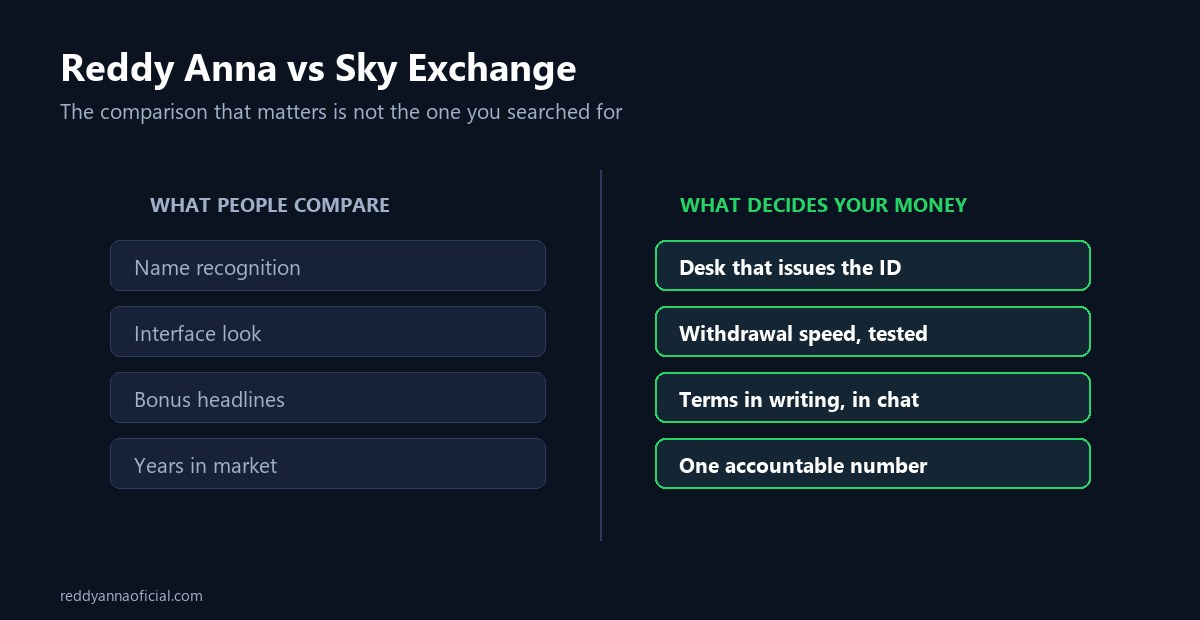
Name recognition, interface polish, bonus headlines, years in the market – the visible comparison points. Here is the honest read on each. Recognition: both names are famous enough that fame tells you nothing; famous names attract clones proportionally, so recognition is as much a risk marker as a trust marker. Interface: whichever platform your ID lands on, the software is broadly commodity – same market types, same back-and-lay mechanics, same in-play flow. Bonuses: headline percentages are marketing; the wagering multiple is the truth, on any name (the two questions to ask). Years in market: age proves the brand idea survived, not that the website in front of you is genuine – the oldest names carry the newest fakes.
Odds, markets and liquidity
The comparison point people care about most deserves its own section. On an exchange, odds are not set by the brand on the login page – they are set by players backing and laying against each other. The same India–Australia match produces essentially the same prices across platforms, because the same pool of opinion is pricing it. Where platforms genuinely differ is liquidity – how much money is waiting to be matched at the price you see – and market depth on smaller events: a big platform brand may show more session and fancy markets on a Tuesday-night domestic game. But here is the twist that folds this back into the desk question: your access to any platform runs through the ID your desk issues. A good desk can hand you a login for a deep-liquidity platform in the same five-minute WhatsApp flow (the step-by-step guide shows exactly how short that flow is). The platform decides what is on the menu; the desk decides whether dinner actually arrives.
What decides your money
Strip the branding and your actual experience is decided by the desk that issued your ID: how fast withdrawals land, whether terms were written down before money moved, whether one accountable number answers at midnight, whether disputes get settled from the platform record, and whether limits survive a winning month. Every one of those is desk-level. A Sky Exchange login reached through a bad desk is a bad experience wearing a famous badge; a modest platform through a straight desk pays like clockwork. This is why Reddy Anna vs Sky Exchange cannot be answered as asked – and why the answerable version is so much more useful: not “which name”, but “which desk, verified how”.
The five checks, applied to both
- One published, accountable number – wherever you got it, can you hold it to anything tomorrow?
- You made first contact – cold offers wearing either name are worked lead-lists, not desks.
- Terms in writing before deposit – minimums, wagering, withdrawal rules, in your chat, first. Written terms are your evidence if anything is ever disputed.
- Payment details issued fresh, privately – the public account number is the clone economy’s engine on both names.
- A small withdrawal in week one – the test no fraud survives and no honest desk fears, whichever logo is on the login.
Can you have both? Switching and stacking
A question the search data says people are quietly asking: do I have to choose? No – and understanding why dissolves the whole comparison. A verified desk can issue IDs across leading platforms (the platform guide maps the landscape), so “having Sky Exchange” and “being with a Reddy Anna desk” are not opposites; for many players they are the same arrangement described from two ends. If you already hold a login somewhere and want to try another platform, the move is one WhatsApp message, not a migration. The only real cost of stacking logins is discipline: every extra balance is another thing to track, and bankroll rules work best on one wallet. Most experienced players settle on one trusted desk and one or two platforms – enough for price and market coverage, few enough to stay honest with themselves.
Three mistakes name-chasers make
Watching players move through this market, the same three errors repeat whenever someone shops by name instead of by desk. Mistake one: searching the name and clicking the top thing that looks official. Famous-name searches are exactly where lookalike domains and rented ads wait; the more famous the name you type, the richer the trap. If a search result is your starting point, verify the desk behind it from scratch with the 10-minute audit – the ranking position proves marketing budget, nothing else. Mistake two: treating the platform badge as a guarantee. A genuine Sky Exchange login screen can sit at the end of a dishonest desk’s funnel; the software being real says nothing about the person handling your money. The badge is the shelf, not the shopkeeper – and your money never touches the shelf. Mistake three: switching names after a bad experience instead of switching process. Someone burned by a clone wearing one name moves to the other name – found the same way, verified just as little – and meets the same script with new branding. The fix after a bad experience is never a different name; it is the five checks, run properly this once. Players who internalise that stop being name-chasers entirely, and their next desk tends to be their last.
Reddy Anna vs Sky Exchange: the honest verdict
Sky Exchange vs Reddy Anna, or the other way round – the order never mattered, because the units were never comparable. If your question was “which name should I trust” – neither, and both: trust is not a property names can carry in a market this cloned. If your question was “where should my ID come from” – from whichever desk passes the five checks, and it can hand you a Sky Exchange login or any other platform’s, as fits. Our desk publishes its own audit (run it), states terms in chat before money, and invites the week-one withdrawal test – and a Sky-badged desk that does the same deserves the same confidence. The name on the door was never the thing keeping your money safe. The process behind it always was.
FAQ
Is Reddy Anna better than Sky Exchange?
Category confusion – one is primarily a desk name, the other a platform name, and both are heavily cloned. The desk that issues your ID decides your experience; the post’s five checks are the real comparison.
Can I get a Sky Exchange ID from a Reddy Anna desk?
Desks issue IDs across leading platforms – ask in the chat. The platform guide explains how that works.
Reddy Anna vs Sky Exchange – which has better odds?
Exchange odds are set by matched players, not by the brand on the login page – the same matches produce essentially the same prices. Platforms differ in liquidity and market depth; desks differ in payouts. Judge each on its own axis.
Both names have scam complaints. Who is safer?
The complaints on both names overwhelmingly describe clones – deposit traps and release-fee scripts. Safety is procedural: the five checks defeat those scripts under any name.
Do I need separate money for each?
Each login has its own balance, so stacking platforms splits your bankroll. Most players keep one main wallet with a verified desk and add a second platform only if a specific market need justifies it.