Every guide on this topic gives you a vague checklist – “check reviews, look professional” – which is exactly why the fake ID provider economy keeps growing: the fakes read those guides too, and they check every vague box. Reviews can be bought; professional design is a template away. This guide does something different. It gives you a 10-minute audit built on things a fake ID provider cannot fake – process behaviours – plus the exact questions to type, verbatim, that make fraud reveal itself in its own chat. Ten minutes of reading here is the cheapest insurance this market sells.
On this page
Why the usual advice fails
Fake providers are not amateurs; a fake ID provider is a conversion-optimised business whose product is your deposit. They have testimonials (written in-house), payment proofs (edited images), years-in-business claims (typed yesterday), and “official” branding (copied from whoever is famous this month). Everything a checklist tells you to look at, they manufacture. What they cannot manufacture is behaviour under process – because the honest behaviours cost them their business model. A fake cannot issue payment details privately per transaction (their model needs one number harvesting many victims). A fake cannot pay a small withdrawal smoothly (paying you is the one thing they exist to avoid). And this holds across the whole product line – a fake cricket ID seller, a fake betting ID desk, a casino-flavoured clone: same scripts, same tells. Audit behaviour, not appearance, and the disguise stops mattering.
Where fakes find you
Knowing the hunting grounds is half the defence, because a fake ID provider rarely waits to be found – it comes to you. The main channels: cold WhatsApp and Telegram messages to numbers bought in bulk (the single biggest channel – if they messaged first, the audit is already over); Telegram groups where “winning tips” funnel members toward a deposit number; comment sections and reply-guys under cricket videos, posting “genuine provider, DM me”; lookalike websites built on famous names, waiting for search traffic; and social media ads run on stolen branding until the ad account is banned, then again from a new one. Notice what all five have in common: the contact is engineered to feel like discovery. The defence is one habit – you choose the provider, from a published, accountable source; providers who choose you are prospecting, not serving.
The seven red flags
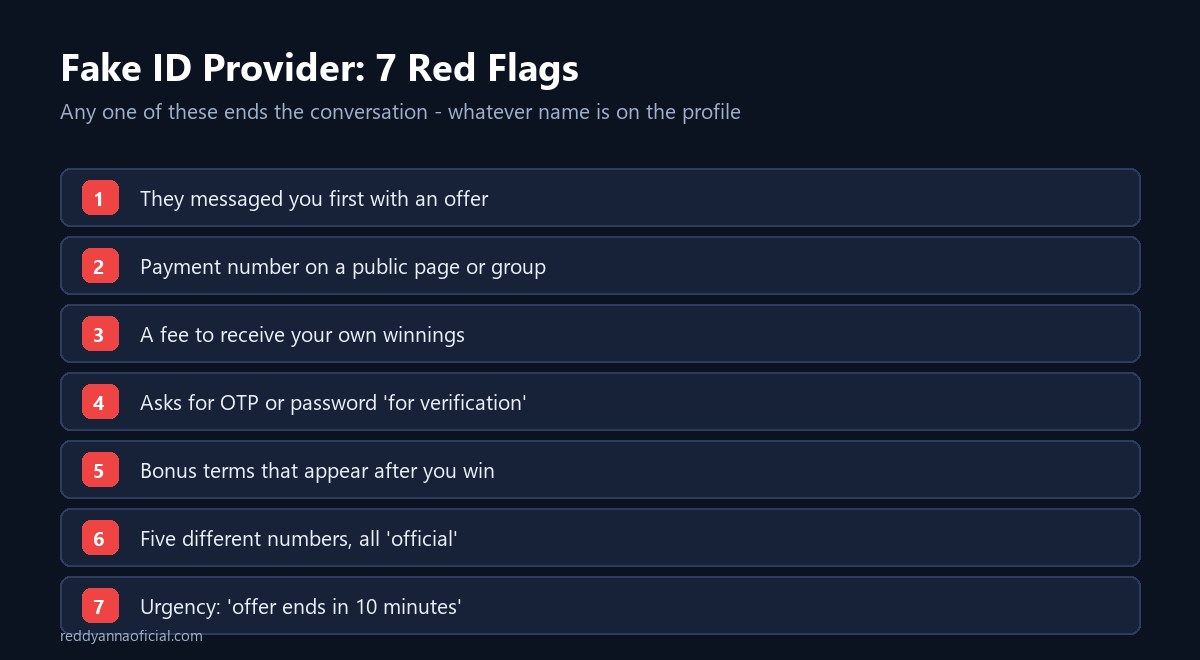
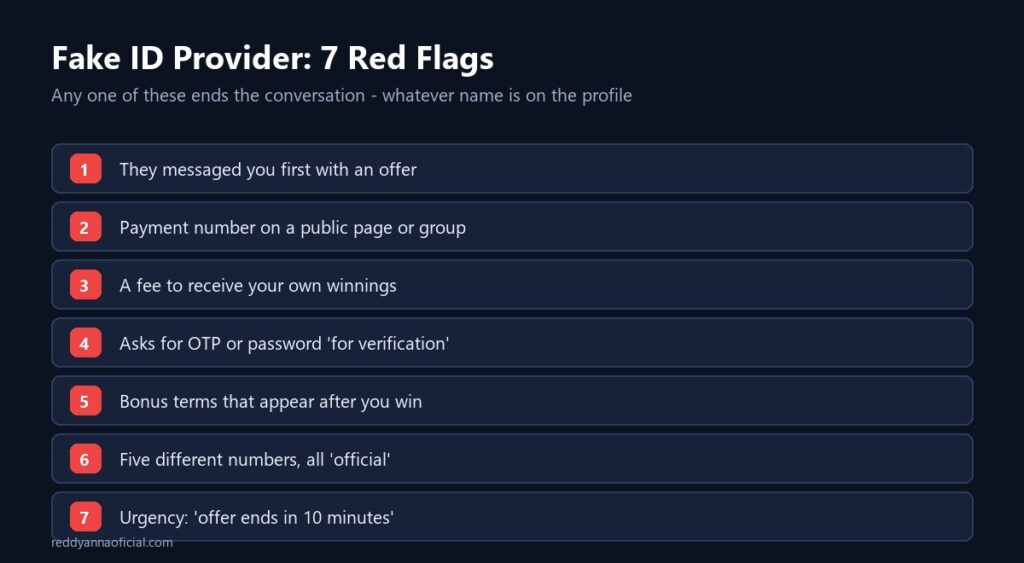
Each of these, alone, ends the conversation: (1) they messaged you first – worked lead-lists, always; (2) payment details on a public page or group – the deposit-harvest engine; (3) any fee to receive money – the release-fee script, no legitimate version exists; (4) requests for OTP or password – account takeover in progress; (5) bonus terms that appear after you win; (6) multiple “official” numbers – accountability dissolved by design; (7) manufactured urgency – countdowns exist to stop you checking. Honest desks fail none of these, ever, because none of the seven has an innocent explanation. Memorise the list or bookmark this page; either way, the flags do the remembering for you when adrenaline will not.
The four scripts every fake runs
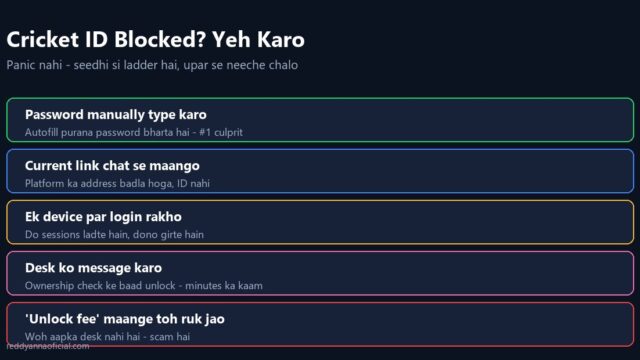
Read a thousand victim accounts and they collapse into four plots. The deposit vanish: pay, then silence – built on flag 2, the public payment number that harvests dozens of deposits a day before the number burns. The release fee: your withdrawal is “approved”, just clear this processing charge first – and the charge regenerates each time it is paid, because the withdrawal was never real. The takeover: “verification” wants your OTP; minutes later the account, and any balance in it, belongs to someone else. The bonus lock: winnings frozen behind wagering terms invented after the win – the only script that runs on real platforms through dishonest desks, which is why written terms before deposit matter so much. Notice the structure: every script needs one of the seven flags to work. Kill the flags, and the scripts have no stage. The release-fee script also has a nastier cousin that targets players whose ID shows as blocked – an “unlock fee” demand that guide dismantles in detail. The deeper anatomy of each script lives on our safety pillar; this post is the field version.
Why famous names carry the most fakes
A counter-intuitive rule that reorganises how you see this market: the more trusted a brand name, the more fakes wear it. A fake ID provider does not invent a brand – inventing trust is expensive and slow – it borrows one. Famous names like Reddy Anna are borrowed constantly precisely because the genuine reputation converts victims faster: the target has already heard the name from a friend, so the fake inherits a warm lead it did nothing to earn. This produces the paradox that confuses every newcomer who searches “is [name] real or fake”: the answer is always both, at scale. The name is real; hundreds of operations wearing it are not; and the ratio of fakes to genuine desks rises with fame. Two practical consequences follow. First, never treat name recognition as a safety signal – recognition is the exact asset the fraud borrowed, so it cannot also be your filter. Second, complaints against a famous name tell you the name is big, not that any desk you found is bad – and glowing mentions tell you nothing either, for the same reason. Both halves of the online reputation are talking about hundreds of different operations at once. (This is also why name-versus-name comparisons mislead – the Reddy Anna vs Daddy Anna post unpacks that trap in full.) The only unit that can be verified is the one in front of you: this number, this chat, this behaviour, audited with the ten minutes this guide gives you.
A composite case study
Here is how the scripts feel from inside, stitched from patterns that repeat across hundreds of public complaints. A player – call him Arjun – joins a Telegram tips group before a big series. After a week of free predictions (some right, by volume and luck), the admin posts: “ID offer closing tonight, special rate, message now.” Arjun messages. The reply is warm, fast, professional – and includes a payment number pinned in the group for everyone (flag 2), with a countdown (flag 7). He deposits. An ID arrives – this is the sophisticated version; the crude version goes silent here – and he even wins a little. Then the withdrawal: “approved, sir, just clear the processing charge.” He pays it. A second charge appears – “bank compliance.” By the third, Arjun realises the withdrawal was never coming, and the total lost is deposit plus two fees. Every beat of that story was flagged in advance by the list above; the warm professionalism changed nothing. Scripts do not need you to be greedy, only hurried.
The 10-minute fake ID provider audit
- Minutes 0–2: provenance. How did you find this provider? Search ad, group forward, cold DM = start over. A published site you navigated to yourself, or a personal referral you trust = continue.
- Minutes 2–4: the number. One number, published where it can be held accountable? Or a fresh WhatsApp with a profile photo of currency notes? The infrastructure tells on the business.
- Minutes 4–7: the questions. Type the three questions from the next section. Watch not just the answers but the manner: specific and instant, or evasive and pushy?
- Minutes 7–10: the terms test. Ask for minimums, bonus wagering and withdrawal rules in writing, in the chat, before paying anything. Refusal or vagueness is your answer.
- Week one: the withdrawal test. Deposit modestly, play lightly, withdraw something small. This is the audit’s final exam and no fake ID provider passes it – paying you contradicts their entire reason for existing.
Questions that make fraud reveal itself
Copy these verbatim. “What are your withdrawal rules and minimums? Put them in this chat before I deposit.” – fakes deflect, because written terms become evidence. “Will payment details come fresh in this chat for my transaction?” – fakes push their public number, because harvesting needs it. “I will test with a small withdrawal in my first week – any problem?” – watch this one closely: honest desks say “of course” in seconds; fakes suddenly discover minimum-withdrawal rules, bonus locks, or urgency about depositing more first. Three questions, ninety seconds of typing, and the mask slips on its own. There is a quiet bonus to this method: even if a fake bluffs through all three answers, you now hold their commitments in writing – and fraud hates paper.
Beyond the chat: website checks
If a website is part of the pitch, three checks take two minutes. Age and depth: clone sites are built in days – a site with real guides, consistent details, and pages that go deeper than a homepage took months, and fraud does not invest months. Consistency: does the number on the site match the number in your chat? Clones often rotate faster than their own pages update; a mismatch is a flag. The search-result trap: never pick a provider from ads or from lookalike domains one letter off a famous name – that is precisely where harvest-pages live (our login guide covers the mirror problem). None of these website checks replaces the chat audit – a decent site proves effort, not honesty – but a failing website ends the matter early.
If you already paid one
The honest triage, without false comfort: money sent to a fake ID provider is rarely recoverable, and anyone who contacts you promising recovery for an upfront fee is the same industry running its second act on victim lists – the “recovery agent” scam feeds on exactly the desperation the first scam created. Stop contact before the next “fee” deepens the loss. Keep the chat and payment references – for any official complaint you choose to file, and to warn the friends who will meet the same script. Report the number inside WhatsApp. Then rebuild the right way: verified desk, terms in writing, small withdrawal first – the sequence this post exists to teach. Full recovery guidance is on the account issues page, and the ID guide walks the clean route step by step.
FAQ
How do I know if an ID provider is real?
Behaviour, not appearance: one accountable number, terms in writing before money, payment details issued privately per transaction, and a small withdrawal paid smoothly in week one. A fake ID provider cannot do these – the post explains why.
Are reviews useful for checking a provider?
Barely – praise is often paid and outrage often planted, and reviews rarely name the desk anyway. Mine complaints for process details (the scripts), ignore verdicts, and run your own audit.
What is the single strongest check?
The week-one small withdrawal. Every other signal can be faked; paying you cannot – it contradicts the fraud’s business model.
A provider asked for a security deposit to activate my ID. Normal?
No – that is the release-fee script running in reverse. A real ID is free; the only money involved is your own playing balance.
The provider messaged me first but seems genuine. Should I continue?
No. Cold outreach is the strongest single marker of a fake ID provider – honest desks do not buy number lists. Whatever warmth follows is sales craft, not service.